
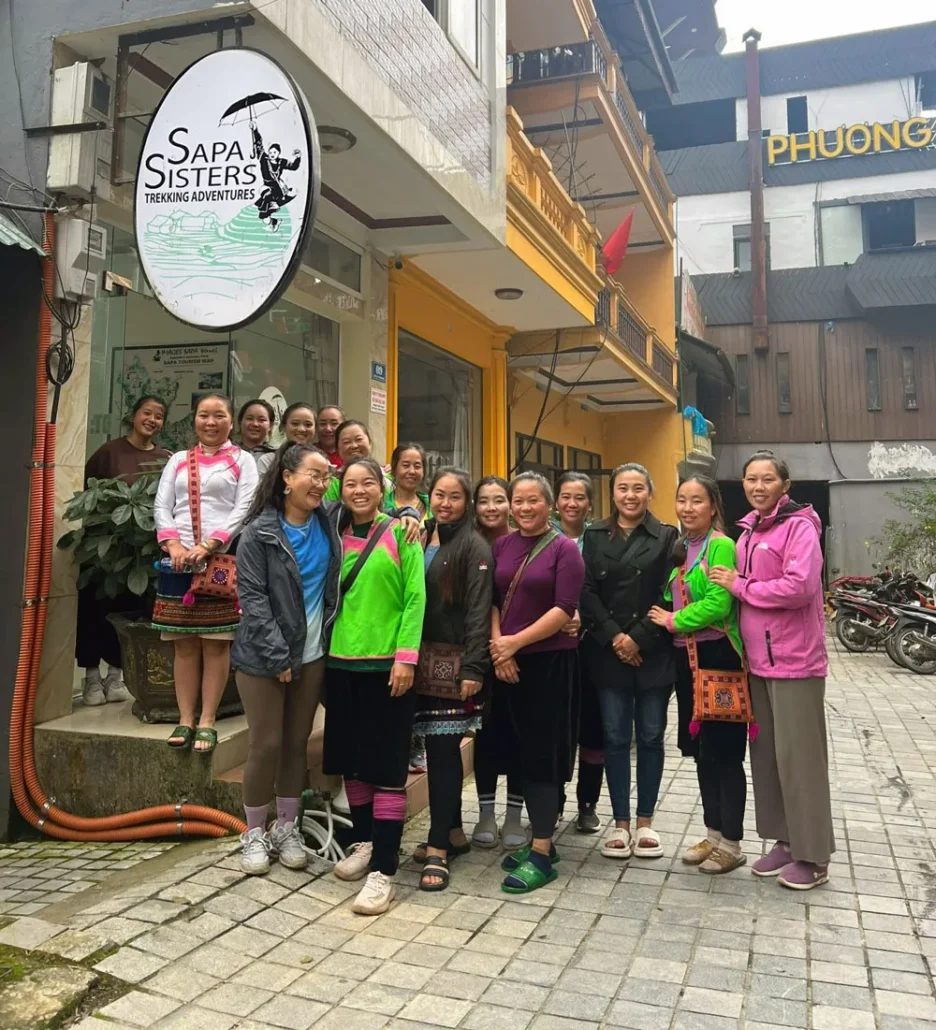
A Hmong-owned, female-led trekking company, and what responsible trekking in Sapa actually looks like in practice.
“Responsible travel” is a phrase you see everywhere. On brochures, in blog posts, on booking platforms. But it’s almost always vague. What does it actually mean for the women leading you through the rice terraces?
At Sapa Sisters, responsibility isn’t marketing. It’s a structure. We’re the only Hmong-owned, female-run trekking company in Sapa, and we built the business around a simple idea: the women guiding you should earn a real living, own their future, and be protected year-round, not just during trekking season.
Here’s what that looks like in 2026.
Who owns Sapa Sisters
Sapa Sisters was founded in 2009 by four Hmong women and two visiting artists who had spent time in Sapa and seen how hard it was for local women to earn decent wages. The idea was to build a company that could sustain itself, with the women from the villages at the center, not as contractors, but as the heart of the business.
Today we are 28 Sapa Sisters guides, a three-person office team in Sapa town, and a four-person booking and accounting team in Hanoi. One of our co-founders, Ylva, runs coordination from Stockholm. But the company belongs to the women who walk its trails.
What we pay, and why it matters
Let’s start with the part most trekking companies won’t talk about: money.
In March 2026, we paid a total of $21,442 USD in guide salaries. On average, our full-time guides earned around $700 USD for the month, plus social insurance.
For context: a typical office worker in Hanoi, a receptionist, an accountant, a junior salesperson, usually earns roughly $400 to $550 USD a month. Many Hmong women from mountain villages, without this kind of work, might earn $150 to $250 a month from day labor or craft sales. The gap isn’t small, and it isn’t abstract.
Pay also scales with how much you trek: busier months earn more. But the baseline is real, and the ceiling matters.
How we invest in our guides beyond salary
Salary is only the start. The pieces underneath take longer to notice, and they’re the ones that actually change lives.
Social insurance for every Sapa Sisters guide. Our full-time guides are enrolled in Vietnam’s social insurance system, which covers pension contributions and medical care. This is the most overlooked gap in Vietnamese tourism. Many trekking companies hire guides as day labor, no safety net, no pension, no protection when someone gets sick. Our core guides have all of it.
(A note on honesty: guides who work only occasionally, on-call during peak demand, aren’t on the same contract. Our full-time team is.)
Autumn and Lunar New Year bonuses. Twice a year, guides receive bonuses based on the number of days they’ve trekked. Two bonus cycles timed to the biggest family celebrations, real extra income when families need it most.
Interest-free loans for investments. Guides who want to buy land, build a house, or invest in their family’s future can take interest-free loans from the company. Land ownership in particular is hard for Hmong women to access through conventional means. We close that gap.
Advanced healthcare in Hanoi. When a guide or her child needs specialist medical care that isn’t available locally, we help arrange and fund treatment in Hanoi. Mountain healthcare has real limits. Ours extends past them.
Legal support in divorce cases. This matters specifically because of both Vietnamese law and Hmong culture. In Hmong tradition, divorce is extremely difficult, and when it happens, women almost always lose custody of their children. Legal advocacy is expensive, complex, and often inaccessible. We cover legal fees for guides navigating this, because economic independence is only real if it’s paired with the ability to protect your family.
Full legal employment. We pay our taxes. We’re connected to the Vietnamese labor union. Our guides are on the books, not off them.
Why structure beats good intentions
A lot of tourism in Sapa is built on good intentions and weak structure. A big agency in Hanoi books a trip. A local guide gets hired for the day. She earns maybe $15 to $20, keeps less after fees, and is sent home. No insurance, no pension, no bonus, no backup if she or her child gets sick. When the season ends, she’s on her own.
That’s the default model in the region. Ours is the exception, and it took years to build it out piece by piece. Salary first. Then insurance. Then bonuses. Then housing loans. Then healthcare. Then legal support. Each layer reinforces the next.
That’s what responsible trekking in Sapa really means, specifically: not statements, not a color on a logo, but a stack of structural commitments that, added together, change how a woman lives and what her daughters will expect from their own work.
Should you book a Sapa guide directly instead of through a company?
You will see this advice in a lot of ethical travel blogs: skip the trekking company, hire a local Hmong guide directly at the bus station or through a contact, and put more money in her pocket. The argument is that travel companies take a cut, so booking direct sends a bigger share to the woman doing the work.
It sounds right. It is also incomplete.
A direct booking pays a guide in cash for the days she works, and that is where the relationship ends. No insurance. No pension. No bonus at Tet. No support when the season is over and the rain shuts down trekking for weeks. None of the structure described above.
A direct booking pays a Hmong guide for one day. Booking with Sapa Sisters supports her for life.
We are not against independent guides. Many are excellent, and for some travelers a direct hire is the right fit. What we push back on is the idea that a single cash payment is “more ethical” than a year-round structure that pays more, protects more, and lasts longer than any one trek.
The economics are not close. A guide working full-time with Sapa Sisters in 2026 earns more in a single month than a freelance bus-station hire might make in three, and that is before you count the protections we already laid out: insurance, bonuses, healthcare, legal support, the interest-free loans that have helped guides buy land in their own names.
So if ethical trekking in Sapa actually matters to you, the question is not “company versus direct.” It is “what does the guide take home, and what happens to her when the season ends?” A good company answers both. A handshake at the bus station only answers the first one, and only on the days you happen to be there.
What this means for you as a traveler
Trekking with Sapa Sisters isn’t charity. You’re paying for a guided experience, and in most cases, a better one than you’d get from a bigger operator. Our guides know these trails because they grew up on them. They know every family in every village you pass. They can bring you into places most tourists never see.
But knowing where your money goes matters. When you book with us:
- More of what you pay stays in the local community, because the company is owned here.
- Your guide has a pension, insurance, and a structure behind her that doesn’t vanish at the end of the season.
- The next generation, the sons and daughters of our guides, grows up seeing a different possibility for their own work and independence.
Sapa is one of the most beautiful places in Vietnam, and a trek here will stay with you for years. Whichever company you choose, choose one where the economics work for the people doing the walking.
Ready to book?
If you’re planning a trek, we’d be honored to guide you. Whether it’s a half-day market visit, a three-day homestay adventure, or a climb up Fansipan, every trek is private and built around your group, fitness level, and interests.
Or email us at contact@sapasisters.com with your dates and what you’d like to do, and we’ll design something that fits.
Frequently asked questions
What makes Sapa Sisters different from other trekking companies in Sapa?
Sapa Sisters is the only Hmong-owned, female-led trekking company in Sapa. All our guides are Hmong women from the surrounding villages, and the company is structured to invest in their long-term livelihoods through fair salary, social insurance, twice-yearly bonuses, interest-free loans, healthcare support, and legal advocacy.
Are your guides paid fairly?
Yes. Our full-time guides earn more on average than a typical office worker in Hanoi, and receive social insurance (pension and medical care), plus two annual bonuses based on how much they have trekked.
Is Sapa Sisters a social enterprise?
Yes. The company was founded in 2009 specifically to provide sustainable, dignified work for Hmong women in Sapa, and has operated on that model ever since.
How many guides does Sapa Sisters have?
In spring 2026, we have 28 Sapa Sisters guides, a five-person office team in Sapa town, and a four-person booking and accounting team in Hanoi.
Is it better to book a Sapa guide directly instead of through a company?
It depends on what you mean by “better.” A direct booking pays a guide in cash for the days she works, and nothing else. Booking with Sapa Sisters means your guide is enrolled in Vietnamese social insurance (pension and medical), receives twice-yearly bonuses, can access interest-free loans to buy land or build a house, gets specialist healthcare support in Hanoi for herself and her children, and has legal fee coverage if she goes through a divorce. Direct bookings cover one day. Booking with us supports a guide year-round, in and out of trekking season.