
Solo Female Travel in Vietnam: A Guide from the Ground
Vietnam is one of the most popular destinations in Southeast Asia for solo female travelers, and the numbers back it up. International arrivals have broken records year after year, and women traveling alone make up a significant and growing share of that traffic. The country rewards curiosity, moves fast, and has a way of surprising you at every turn.
But most travel content about Vietnam sells the highlight reel without the footnotes. This guide tries to do something different: give you an honest picture of what solo female travel in Vietnam actually feels like, the good and the difficult, so you can arrive prepared and leave with the trip you came for.
Is Vietnam Safe for Solo Female Travelers?
Yes, and it consistently ranks among the safer countries in Southeast Asia for women traveling alone. Violent crime targeting tourists is rare. The general culture is not aggressive toward solo women, and in most situations locals are helpful rather than threatening.
That said, “safe” and “easy” are not the same thing. Vietnam can be an intense place to travel. The difference between a great trip and an exhausting one often comes down to managing that intensity rather than avoiding danger.
The Intensity Is Real (and Worth Naming)
Here is the thing that catches many solo travelers off guard: Vietnam presses in on you.
The traffic in cities like Hanoi and Ho Chi Minh City is famously relentless. Crossing the street requires a kind of patient, steady confidence that takes a few days to build. The streets around major markets and tourist areas can mean vendors approaching you continuously, offers of tuk-tuks and tours, people calling out as you walk past. None of it is malicious. Much of it comes from communities where tourism is one of the only economic options available. Understanding the context helps.
But when you are traveling alone, without someone to deflect with or laugh with, this kind of sustained social pressure can be draining in a way that is hard to predict until you are in it. The moments that feel like nothing on a group trip can stack up fast when you are solo.
The good news is that this intensity is front-loaded. After a few days in Vietnam, most travelers find their footing. You learn to walk with purpose. You get better at the gentle, firm “no thank you.” You stop tensing up at every motorbike horn. The country starts to open up in a completely different way once that adjustment settles in.
The “Say Yes” Philosophy
A solo traveler who had spent several weeks moving through the country said: “At some point I decided I was going to say yes to things as they came up, instead of sticking to what I had planned. That one decision led me to more remarkable places and conversations than anything I had researched in advance.”
It is not a call to abandon common sense. It is an invitation to loosen your grip on the itinerary and step outside your comfort zone, because that is what adventure actually is. The cup of tea offered in a small family shop. The side street that looks interesting. The suggestion from your guide to take a longer path because the view is better. Challenging yourself to say yes, even when the easier answer is no, is where the best stories come from. Vietnam rewards that kind of openness more than almost any other country, because so much of what makes it extraordinary is not on any map.
Getting the Balance Right
Solo travel anywhere is a negotiation between independence and loneliness, between adventure and overwhelm. Vietnam turns the dial up on both.
A few things that help:
Build in rest. If you are moving through the country quickly, the travel itself becomes its own kind of exhaustion. Give yourself at least one place where you stay long enough to stop being a tourist and start being a visitor.
Get out of the cities when you need to breathe. The urban centers are exhilarating but relentless. The countryside, and especially the north, operates at a completely different pace. A few days in the mountains or the delta can reset everything.
Travel with a local female guide for at least part of the trip. This is not about safety (though that is a bonus). It is about access, and it is about company. A good local female guide changes what you see, what you understand, and how welcomed you feel in the places you pass through. She is also someone to laugh with, which matters more than most travel guides will tell you.
Trust the slow mornings. Vietnam before 8am belongs to a different world: street vendors setting up, old men doing tai chi in the parks, the light doing extraordinary things. Some of the best experiences of a solo trip happen before most tourists have finished breakfast.
Why Sapa Belongs on Your List
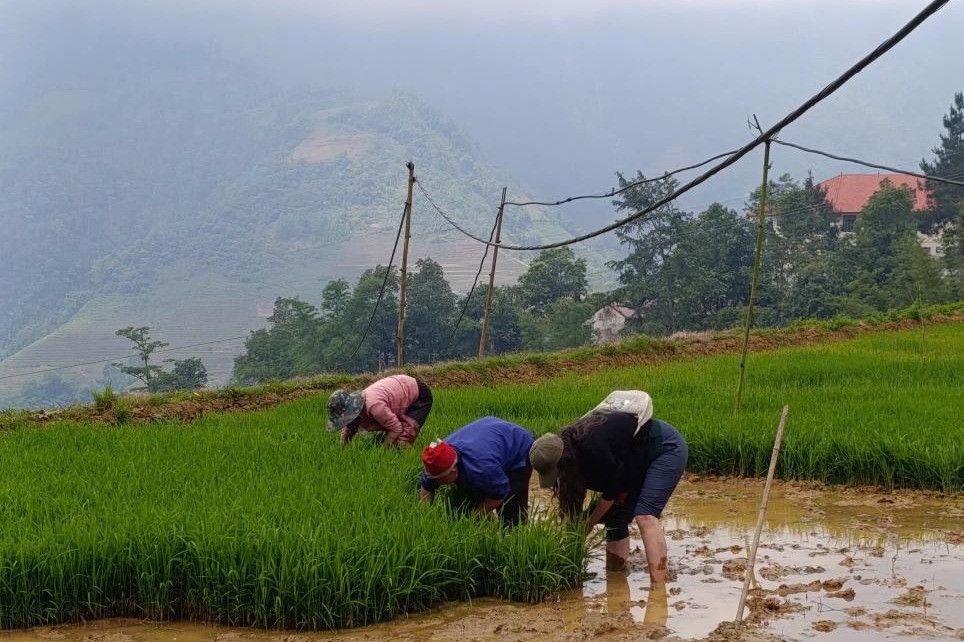
Sapa is easy to reach from Hanoi: an overnight train to Lao Cai, then a short ride up into the mountains. From the moment you arrive the landscape does its thing. Terraced rice fields, deep valleys, village paths that wind through working farmland. The trekking here is some of the best in Southeast Asia, not because it is technically demanding but because every trail goes somewhere real.
The food is worth the trip on its own. Thang co (a traditional Hmong stew), grilled corn from the market, fresh vegetables that taste like they were grown an hour ago. Eating in Sapa feels nothing like eating in a tourist town.
And then there are the people.
The Women Who Run Sapa
One thing that makes Sapa genuinely unlike other trekking destinations in Southeast Asia is this: the women are in charge.
In Hmong culture in this region, it is the women who handle business, who speak multiple languages, who navigate the world outside the village. Many Hmong men speak neither English nor Vietnamese, so it is the women who trade, who guide, who run the market stalls, who negotiate, who make things happen. When you arrive in Sapa, the people approaching you, helping you, selling to you, and guiding you are almost always women.
This is not a tourism narrative. It is simply how things work here, and it gives Sapa a character that is hard to find anywhere else. There is a directness to it, and a lot of humor. Hmong women are famously quick-witted and will absolutely make fun of you if you do something clumsy on the trail, in the warmest possible way. The laughter comes fast up here. It is part of what makes trekking in Sapa so disarmingly good.
For solo female travelers especially, there is something grounding about arriving in a place where the women are visibly the ones holding everything together. It changes the texture of the whole experience.
Trekking With a Local Guide
Sapa Sisters is a Hmong-owned, women-led trekking company that has been running treks in Sapa and Ha Giang since 2009. All guides are local women from the Hmong and Dao communities you walk through. When you trek with a Sapa Sisters guide, you are not just getting someone who knows the paths. You are getting a woman who grew up here, who speaks the local language, who can open doors (sometimes literally) that no map will ever show you.
Treks range from single-day routes to multi-day programs with village homestays. For solo travelers, the homestay option is particularly worth considering: a chance to slow down, eat with a family, and experience Sapa at a pace the town itself does not always allow. Programs also run in Ha Giang for those wanting to extend further north.
Sapa Sisters has been running treks in Sapa and Ha Giang since 2009. A Hmong-owned, women-led trekking company, with guides from the local communities you will walk through. [Book your trek here.]
Frequently Asked Questions
Is Vietnam safe for solo female travelers?
Yes. Vietnam has a low rate of serious crime against tourists and is considered one of the safer countries in Southeast Asia for women traveling alone. It ranks 38th out of 163 countries on the Global Peace Index, putting it just below Sweden at 35th — and well into the green. The main challenges are not safety-related: they are the intensity of busy areas, persistent vendor attention, and traffic. These ease significantly after the first few days.
One thing that many solo female travelers appreciate about Vietnam is the freedom around how you dress. There are no widespread social expectations or dress codes imposed on women visitors, and you are unlikely to face judgment or unwanted attention based on your clothing. For travelers coming from destinations where this kind of freedom is less straightforward, it can feel like a genuine relief. (A light shawl is still worth carrying for temple visits, as a basic courtesy to the site, but this applies equally to all visitors regardless of gender.)
What should I pack as a female traveler in Vietnam?
A few things worth knowing before you start packing. Toilet paper is not always provided in public bathrooms, so keep some in your bag. Most common medicines, including painkillers, stomach remedies, and basic bandages, are easy to find in any pharmacy once you are there, so no need to bring a full travel kit from home. Tampons are available in cities but larger sizes can be hard to find outside urban areas, so bring what you need. Keep valuables simple: Vietnam is safe, but there is no reason to travel with your most precious jewelry. And try to consolidate your bags as much as possible. Multiple small bags are easy to leave behind on buses, boats, and motorbikes.
One practical but easy-to-forget rule: always carry your passport if you are planning to stay overnight anywhere. Every accommodation in Vietnam is legally required to register guests who stay the night, and they cannot do that without your passport. Leaving it in a locker back at your last guesthouse will cause problems.
What solo female travel in Vietnam really feels like, the good, the intense, and why Sapa is worth it.
The trails themselves are not dangerous, but navigating them without local knowledge is genuinely difficult. Many of the best routes pass through private farmland, and the paths are unmarked. Trekking with a local guide, particularly one connected to the communities you are walking through, is both safer and a far richer experience. Sapa Sisters guides are all local Hmong and Dao women who have been trekking these routes for years.
Wandering off alone is not recommended, and this applies equally to men and women. If you do go out independently, always tell someone where you are going and when you expect to be back. Accidents happen, particularly with travelers attempting to climb Fansipan alone without proper preparation. During dry season, grass and scrub fires can move quickly across the upper mountain slopes, and you do not want to find yourself walking into one as it comes over a ridge. There are also dams in the valleys below, and they can be opened with very little notice. If you are in a valley when water is released upstream, the situation changes fast. A local guide knows these risks and knows the land. That is reason enough.
How do I handle vendor pressure as a solo traveler?
Firm, friendly, and brief. A clear “no thank you” delivered without breaking stride is the most effective response. Engaging, even to explain why you are not interested, tends to extend rather than end the interaction. It takes a few days to feel natural, but it does become natural.
One specific trap: when a vendor follows up with “Maybe you buy tomorrow?” do not say “maybe.” They will remember, and they will find you tomorrow. A kind but clear “no” is kinder in the long run, for both of you.